Calm

…before the storm. Tomorrow we get in Sweet Charity. There’s not much time to blog when you’re focussed on the task so by way of update Rob & I have shot 136GB of rehearsal video, designed the rig, plotted 225 lx cues, fettled the plans (overstage, FoH, booms, section, set/stage/focus points, scene-by-scene, lx-everything), made the lx practicals, found some followspot crew and even done a bit of carpentry to help the set along. One set of hires is in the venue, the other is loaded in the van. The car is loaded with ropelight, nylon cord, hard hats, hi viz, toe-tectors, just-in-case items (DMX, black wrap, glow tape), and my magic blue box (colour, frost, gobos, plans, bar tapes, USB key with show file, tools, tape measures, gopro). Lunch! Damnit, mustn’t forget the things in the fridge or the biscuits for the crew; don’t want a mutiny.

So the theory is good – hours in advance save minutes on the day and minutes on the day are finite; we’ve done the prep. Tomorrow we find out if it works. Most of the day will be spent rigging, cabling, addressing, patching. Some of it focussing. The actual percentage of the day spent looking at the lighting to make it better will be very small so we have to make those bits really count.

Brain ought to relax now. The show’s all loaded in vehicles, and, barring things from the fridge which have to be tomorrow, can’t be forgotten. Brain is the weak point now. Being at home with multiple computers and a visualizer to marshal the information is all well and good; at some point tomorrow, brain will have to recall (unaided) how all 103 lights point, zoom, shutter, and what on earth it was thinking when it originally plotted all those cues. Ok, so I try to write focus notes, but 3D problems don’t map well into English. Early night, won’t sleep, early rise, stare at the information and memorise it. Oh, and colour palettes. My brain thinks they’re colour A, lighting desk says colour B, visualiser colours C,D,E,F for each of the different fixture types. Trying to remember what you aimed for when watching multiple wrong versions of the truth is a headache at best.

Apprehension. How many crew? What is pre-rigged? What will go wrong? What haven’t we thought about? Have to be nimble; the plan is good, but must adapt and change as the day wears on. Going to be on a mission tomorrow to get it rigged and focussed so we can actually do the creative bit; must keep the energy up; must remember to eat and drink. Oh yes, and the big one – will it work as a design, or is it going to be a very long week? Tomorrow is the moment of reckoning.

It’s a privilege to work with the talented people who are trying to make this show happen. It could be good. It should be good. All we need is a little luck along the way…

Evolution

How has the job of the lighting designer changed over time? Having looked after CUTAZZ’s annual dance show for a long time now I thought I’d pause to reflect.

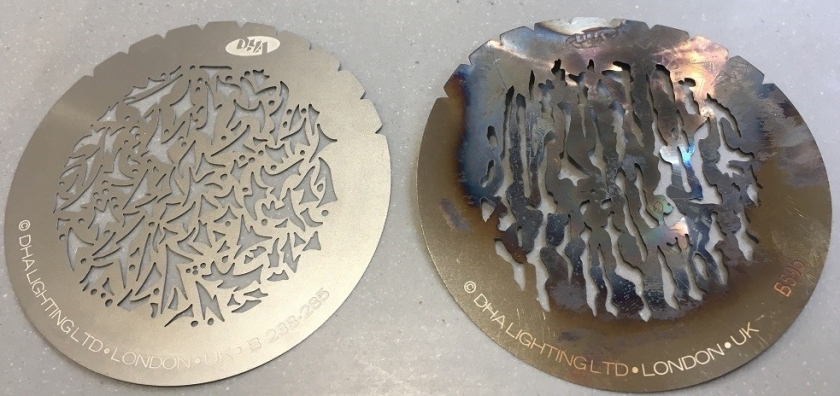
The first year I lit the show was all change – new lighting designer (muggins!), and a newly refitted Mumford theatre – so new lighting desk (ETC Ion) and a pile of Source 4 profiles. The new profiles have a much cooler beam and effectively mean gobos can now last forever – compare and constrast the following:
img_04421.jpg

There was the usual constraint of having to send the lx plan in before having seen any run throughs. That first rig was a fairly traditional dance rig – as many colours of sidelight as the PAR can pile would allow, some shins, two colours of backlight, a breakup wash, some cyc colours. Specials were four gobos, a fan of 6 PAR Cans, two floods for some shadow-play on the cyc and three areas (DSL, DSR, MSC). Even back in 2011 I had a primitive visualiser (WYSIWYG design) so was able to draw a plan with confidence the focus would go well. Video had already found its way onto the techno-must-have list and I duly wandered off to video the two weekend run-throughs.

The brief from the company was simple back then – “most dances will consist of just one set lighting state throughout the dance. A few will require a little bit more but it will still only be 3/4 cues per dance. There are 21 dances in the show.” They were concerned about not over-running the three hour lighting plot and the costs of venue overtime. So preparing to plot was a two stage process – the first a “rough states” spreadsheet with one line per dance, capturing costume notes, possible colour combinations and any specials. From this a more detailed “cues” spreadsheet was built with fade times, notes for each state, approximate music and visual cues. Armed with this information the show was plotted over cans in the Mumford; venue tech on the Ion, me in the middle of the auditorium with my laptop. I surprised the company by sticking to the plot time – annoyingly it turned out there was a spare hour in the plan “because everyone overruns”(!) I hadn’t stuck to the “one state per piece” rule either though mostly where I hadn’t the states were easily related (state, add spot, remove spot, or alterating verse state vs chorus state). Plotting 117 cues in 3 hours is one every 90 seconds, or about 3 minutes to build from scratch, adjust and look at each state once you factor our the duplicates and the blackouts. I hate to think we used to plot this way. And don’t forget the three(!) effects – actually they were four but the latter was done manually with flash buttons.

That first year was well received; it was also an excellent spring-board for the following year. It’s always a massive advantage to have lit a venue or a similar show before; the 2012 rig was an evolution with many subtle changes based on learning from the previous year. The colour palette was updated – partly for colour changes but also to try and maximise the light output of the sidelight when covering a huge stage. Subtle tweaks to the backlight positioning and focus also led to more useable light on stage. Plus more time to think about adding gobos and changing the specials.

2012 was also the first year I’d stumped up for the full version of WYSIWYG Perform. The idea is simple enough – you connect your lighting desk offline editor to the Visualiser, and as you programme the show into the offline, the visualiser shows you what it looks like. Back then it was a revelation. No more truly “blind plot” – no more staring at a screen full of percentages and trying to imagine what it might look like. There was still the issue of the offline occasionally throwing out spurious DMX frames – it did this so you couldn’t use it instead of buying a real lighting desk. But the main issue was calibration – how would the show look like on stage vs in the visualiser? Fortunately this went well – the usual 3 hour frantic plot session replaced with “does this look ok? Next cue….”. The show had grown to 24 numbers and crept up to 150 lighting cues. Being able to plot at home meant being able to devote two whole days to the plot; time was still the enemy however as the offline editor is a rather slower thing to programme than the real lighting desk.
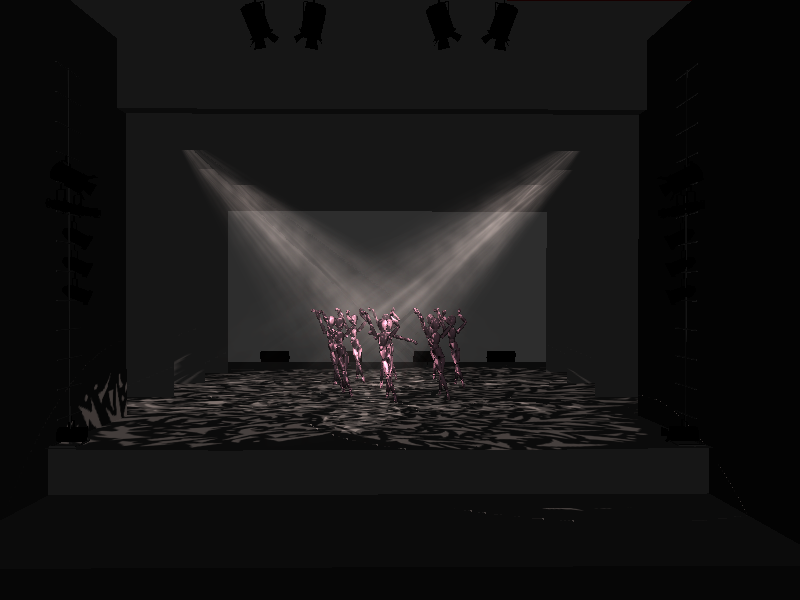
Breakup

2012 was also the first year I had the pipe-tape printer – basically a 1:1 scale lighting plan you drop onto the lx bar. Also deployed for the first time on the dance show it lets you get lights positioned much more accurately – which is helpful when you have geometric beam patterns and the like. Hires that year extended to a haze machine and an Atomic 3000 Strobe.

2013 brought a small but welcome innovation – multiple cue lists in the lighting desk. All the dance numbers were now separate cue lists; more manageable, more logical and sensible cue numbers – and much easier to deal with when the company changes the running order. The only slight panic it caused was when the venue loaded all 227 lx cues into the desk but all the screen showed was “prestate, blackout”. Yes, now at 28 dance numbers and with the visualiser tamed the number of cues in the show had roughly doubled. 2013 also saw heavy use of Intensity Palettes in the pre-plot – making the Wednesday “quick look and fix” session more efficient. States that were meant to look the same now did having tweaked only the first of them. Likewise balancing four colours to get the intended colour mixing on the cyc only had to be done once per colour.

2014’s innovation was timecode. Until that point timing of cues had been via one of two means. Approximate timing in the music happened by someone watching the CD player and reading out the display over cans. Anything more precise required watching the dance rehearsal video and basically memorizing it. Together with the ability to offline visualise and plot it was getting to be quite a lot to remember and running the live show was nothing if not adrenaline filled. Timecode let me set cues exactly where I wanted them in the music – and with such accuracy it opened up whole new ways of plotting. Particularly for effects, flashes and big finishes things you would never dream of trying to do manually were now possible. 90% of the 246 cues were run this way the rest remaining as visuals. Timecode has its costs – it is hugely more time-consuming setting the cue points in pre-plot. One of its main advantages is that more of the dress rehearsal can be spent worrying about light levels and the look of the show – without also having to operate flash buttons, poke GO a zillion times and count eights and seconds in your head. Running the show brought very mixed emotions; delighted at how sharp the cues could be it is hard to describe how flat I felt after the first night. There’s something magic about opping a live show, focussing intently on the dance and the music, keeping a wary eye on the desk and generally trying to do a million things at once without cocking it up. I’m sure timecode is more reliable but it was way less fun. I did bits of the finale on flash buttons just to cheer myself up.

2015 saw the hire of a “proper” haze machine – able to go from “no haze” to “haze everywhere” in seconds. The main learning point was “don’t test this in the kitchen”

2016 was all change with the show moving from the Mumford to the Leys Great Hall. All the work of a new venue – positions, angles and focus, side and top masking all done from scratch. The rig was now a mixed LED and conventional rig. And with two washes of colour-changing units for the backlight and sidelight you end up with far fewer units. The first show in the Leys weighed in at 87 lights (all the Mumford rigs had been over a hundred units). You have less to focus when one wash can do any colour but it costs you time checking your colours actually look nice. I’d settled on a palette of about 16 colours; the new hell being to keep a clear idea in my head what colour I wanted them to be in the venue (different to what the visualiser thought they looked like, which was different again to what the lighting desk’s colour picker thought they looked like). One day the world will calibrate this stuff properly! There’s more setup too – the lights have fixture modes, dimming curves and other parameters to manage; the 87 control channels plus the venue house lighting end up mapped across five universes of DMX in total. On the plus side it was great not to be reliant on three colours of PAR can for the sidelight; on the minus the LED light quality simply isn’t as nice as tungsten or discharge. It’s hard to say what’s missing – but something definitely is.

I also discovered Show Cue System in 2016; no more having to find an Apple Mac just to run timecode in QLab. It’s quite a capable bit of software and its pricing and license model are very reasonable.

2017 got off to an expensive start with the purchase of a programming wing. It’s equivalent to the main control surface of the lighting desk minus all the submaster faders. Together with two touch-screens it makes offline plotting a lot easier than with a QWERTY keyboard. It can also spit out real DMX and Ethernet control frames – no more visualizer glitches from “offline” mode. Unlike the normal offline editor it also connects to real external MIDI sources – so for the first time it was possible to test the timecoding (Show Cue System + MIDI + lighting desk + visualizer) prior to leaving for the venue. Also on the expensive list was a GoPro camera. I first bought a video camera for rehearsal in 2009 – it had been a massive help and a great productivity boost; however, you always ended up filimg rehearsals rather than watching them. And rehearsal rooms are never large enough – you end up filming from at most a metre in front of the “stage” space. Hence the massively wide-angle GoPro – now the camera just sits there and captures everything and I can concentrate on making notes and thinking about what I’m watching.

And 2018? We made hanging booms work at the Leys. So now the colour-key sidelight is much closer to body height but not so low it causes problems with entrances and exits. And it’s in a different place and from a different angle to the general lavender wash – so the two compliment each other rather than washing each other out. Not rocket science but still a welcome improvement. Also, a full 19 years after I’d first put moving lights in a show, we eeked out the budget to include two movers. Ok they only picked off some of the specials but it hints at a world where such things are more affordable and if cost can be squeezed out elsewhere it’s possible they could be more of a feature in future years.

Overall then a lot has changed. The basics are quicker and easier and the tools are better – but more can be done with them and more is possible – indeed expected. The unchanging thing is that time is still the enemy: there are 50 percent more dance numbers in the show and four times as many lighting cues but there’s still only the Monday and Tuesday between first seeing the show in costume and having to be plotted. The world has changed around us too – a non-moving light design tends to be the exception not the rule today and people are used to the eye candy they see on television and at live events – the show has some catching up to do here. I’m glad to say some things haven’t changed – the nuts and bolts of colours and angles and how they play with form and movement are still important; the dance is ever changing and the performers’ enthusiasm undimmed. The live spectacle is always something special.
Moment

That moment. Suddenly you are confronted with your design, live and projected onto real people a few feet away from you. Not the badly rendered computer simulation, nor the messy black box of an empty stage with light thrown at it where all you can see is how well black paint takes light; the actual real thing, fully three dimensional, animated, rendered on flesh and blood, moving before you very eyes. Yes, obviously, that was the plan. But the moment it’s suddenly real can be quite emotional. Reality is brutal – the answer to the hard work is instinctive and delivered in a hearbeat, positive or negative.

It took a while this year. I didn’t get that moment looking over the plot; mostly ok. I didn’t get that moment watching from the control room; mostly insulated from the show you can largely see your reflection  in the glass with a strong hint of blue working light, and you’re too focussed on checking everything works. But for three minutes I escaped to the circle and watched it out front. Live. Captivating. Spine-tingling, electric. It looked really pretty. The headache of rehearsal, the faff of programming hundreds of cues, the misery of the effects engine, the madness of making 29 things all look different to each other, the still fresh aches and bruises from the rig and focus, the tiredness… all melted away. No matter how briefly you are in the moment it wipes away the cost of the effort and the hard work. It doesn’t matter that I can’t explain to normal human beings why the quality of light and its evolution over time fascinates me; it’s enough I’ve got my theatre fix. Who knows, I might do this again sometime!

It’s also a privilege to work with some incredibly talented people, each of whom is worrying about whatever gives them their “moment”. I know enough to know that what they perform is way beyond my reach, and that what they do is as alien to my skill set as what I do is to theirs. But together we make a show.

It’s probably bedtime; I’ve discovered the flaw in blogs – there’s no time to actually write them while you’re busy doing what you blog about. But I’m watching the video from tonight’s dress. Tomorrow is back to the mundane – rehearsal notes, tweaking, getting ready. Tomorrow we open the show; tonight I relive the moment.

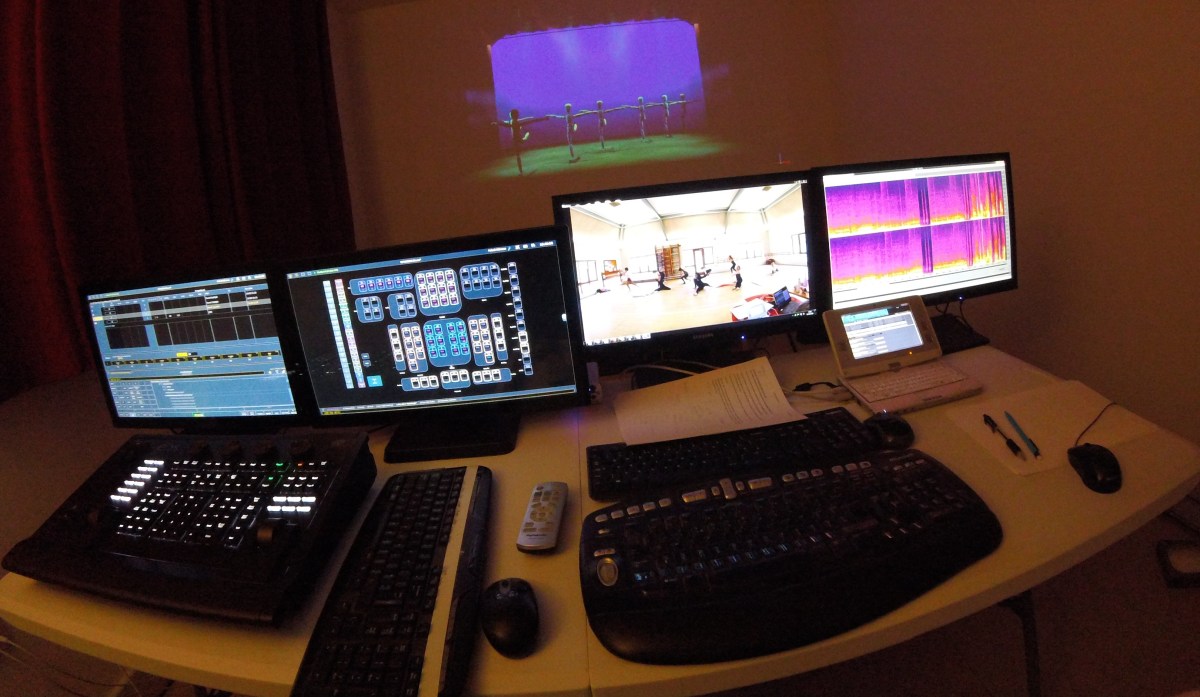
Obligatory plotting photo

It begins. Main screens left to right are Eos (cue sheet, magic sheet), rehearsal video, audio editor in spectral view. Eos connects to WYSIWYG which renders what it should look like onto the projection screen in the distance. Laptop in the foreground is running Show Cue System (sound files for the show and also timecode into the programming wing). Not shown is the spreadsheet of doom that knows everything. The pile of paper on the right has transitioned from a tidy word doc to one-page-per-piece scribbled-upon-in-rehearsal thing.

Tipping point

Today was the day that the sliding puzzle fixed itself. Hires booked; rig finalised, desk and WYSIWYG patched, some last minute faff about fixture modes, groups plotted, colour palettes sorted, magic sheet created, 29 empty timecode lists attached to 29 empty cue lists.

Yesterday was the first weekend run-through. Sadly almost no costume, so the video’s useful for spacing but not for colour. Going to be an odd week trying to get things plotted on the basis of what I have. But there might actually be time to get the effects right for the flashier bits. Time will tell.

Tomorrow… might actually have to try plotting something…

Hyper-procrastination

There isn’t really a word for it. I’m talking about the transition between procrastination (when the show is in the future and life is getting in the way of all those good intentions of starting earlier), and panic (when possibilities are bounded solely by the available time). That time when it’s definitely time to start making the show happen, but that the actual creative part of the process doesn’t quite want to start within your brain. The time to do all the getting started stuff that doesn’t really advance the design but somehow still needs doing. Time to do those things with a sense of urgency so that the thing that really needs doing is all that’s left.

Today was that day. So the show network was booted for the first time since July and Windows Update did its worst to the Eos box and the SCS laptop. Wysiwyg updated to version 40 on the media centre and desktop and the Eos box updated to 2.6.4. The show being a dance show meant the show spreadsheet was fettled; choreographers, titles, music, timecode start, number of performers, length, and rehearsal video links all collated. Music and SCS files sync’d with the sound designer. Plot desk assembled. Revision control applied and synchronised across all machines. Many many e-mails.

There is a reason days like this happen; it’s because the pieces haven’t yet fallen into place. Everything still depends on everything. The rig plan depends on the choreo requests (yet to arrive) but also on what the budget can afford. The generic budget is the remainder after the specials. But how to spend that depends on what the intended lighting plots have in common in order to get good use from it, and that hasn’t clicked into place yet, and also depends on what’s in the rest of the rig. And what to get for the budget depends on second guessing what hire companies will offer for the budget. Where to start.

Somehow though all the displacement activity helps … pieces of the show start to form in the mind… thoughts wrestle other thoughts and contend for budget and lanterns.

The rig is the obvious place to start. One of the advantages of having lit the previous year’s show in the same venue is that the nuts and bolts “just work”; no worrying about every angle of every last fixture just to cover off frontlight, backlight, sidelight, cyc. Instead it’s a case of what worked and what could be improved. A gripe of previous years was having the sidelight overhead (pipe-ends) – this arising because of the Great Hall’s upstage-downstage masking and lack of booms. This was always annoying because the general cover and the sidelight colours end up at nearly the same angle, so it looks less sculptural, and the cover washes out the sidelight. New plan: hanging booms. Low sidelight for strong colours, general cover from pipe-ends as before. Dancer-colision-proof. Looks a whole lot better in Wysiwyg… now to make it happen.

Sidelight is love-hate. Love looking at it, hate rigging it. And so it proves – a bazillion scaffolding bits are now essential to hire, and there’ll be more to do and fewer lights pre-rigged at the get-in. Monumental faff: masking the show, having entrances, hanging booms. Almost “choose any two”. I think I have a cunning plan.

The basics of the rig are in place; the black box can have coloured light from most angles and the odd bit of breakup. It’s a start but it’s not a show. What’s left is a small pile of profiles which provoked some furtling in the gobo collection. And that’s this week’s challenge – to second guess what’s needed for the show, add known specials, subtract anything expensive from the budget, marry up the leftovers with some ideas that are useable in multiple numbers but that might help each of the 29 numbers look different. The big unknown is any gobo purchases; without these there might be enough to get maybe a pair of wobblies – not a lot but would easily pick off all the over-stage soft specials (centre stage clumps etc). Although there are cheaper/smaller things (Spikie, LEDbeam) that could be used to good effect and might fit the budget – there’d need to be more of them though. And no, the budget hasn’t changed since last year.

It’s a start. Standby “CUTAZZ Elevate”….

Here we go again…

It feels like an eternity since I last had a show to think about – Priscilla was back in July and I’ve had an unusually empty diary since then. I’m off to watch the show recording tonight – as usual, dreading what the video recording will have done to the lighting design. But it’ll be nice to see the cast again and catch up with some friends.

But to the future – much like the proverbial No.11 bus, no shows, then three come along at once. All within a week. Two of them are probably firmly in the calendar, and one is very tempting, but who knows whether the rehearsal schedules will allow this. Last time I took on two shows that close together it nearly killed me.

But it’s a dance show that pre-occupies me today. And with it one of the attendant madnesses of lighting design. Budget. I want to work some moving lights into the show; it’s crying out for it and it would really enhance the show but the budget has never allowed it. I’ve poked the company and they’ve quite sensibly asked what I’d like to spend. Realistically they’re not going to add a zero onto last year’s budget but it might just reach the sort of price where I could get four to six movers and really make them earn their money. Some serendipity is required in terms of hire companies, how busy they are and what discounts they might offer. Which is the other madness – that of list price. Nobody pays list price; discounts of 30-60% are achievable. But it makes working out what you might get for your budget near impossible.

I’ve created the Wyg model. Ok, it’s the washes and boring bits from last years show minus all the specials and fun stuff, but that saves time and allows a quick bit of experimentation. So here I am, rushing to look at what movers might make sense, if my guesses about list price, discount and availability are correct, in order to generate a number that aligns with my guess about what the company can budget, in time for a meeting this week, all for a show I’ve yet to see a rehearsal for. This never feels like how shows should start, but shows have to start somewhere. I’ve put the extra days of programming time in my diary to plot with the movers; all I need to do now is convince the company they want to bring costume to rehearsal a week earlier otherwise it’s all for nought. As I said, serendipity required….

Still, I’ve crashed Wyg for the first time on this project, so it’s starting to feel like a show already….